


Your retail partners went live. Has your pilot?
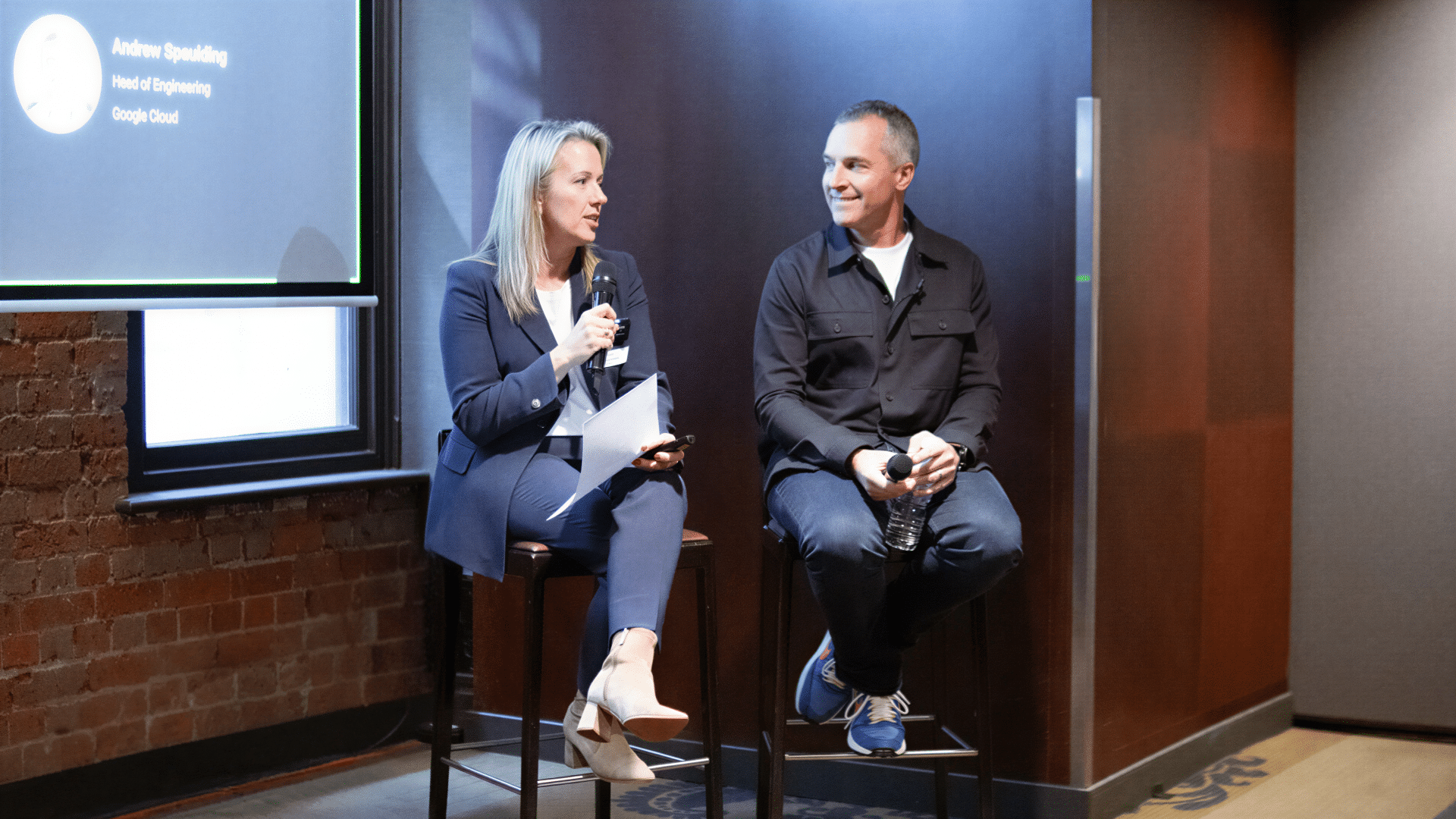
Google Cloud’s Andrew Spaulding on why the last 20 per cent of an AI project is an organisational problem, not an engineering one.
Most AI work in the FMCG industry gets to about 80 per cent and stops, a pattern Andrew Spaulding sees globally and across many industries: pilots and proofs of concept everywhere, and almost nowhere the final 20 per cent that takes a thing into production. The work is real and the early results are often encouraging, but it stalls just short of production, which is the only place value reaches the P&L.
That gap was the subject of our AI Advantage in FMCG sessions, and it is the gap Andrew spends his working life inside. Andrew leads the customer engineering practice for Google Cloud in Australia and New Zealand, and he sat down with Kylie Gleeson, Quantium’s Group Executive and Global Head of Retail and Consumer, to talk through what he is seeing across the industry. Technology barely came up, which is surprising from someone who could easily have spent the hour on architecture. His point was that a pilot almost never stalls for technical reasons. AI capability has climbed close to vertically over two years, while the way most businesses plan, resource and govern their work has carried on along the same flat line it always followed. The gap between those two curves is where every stalled pilot is sitting, and no amount of model selection closes it.
Your retail partners are already live
Walk the Australian market and the customer-facing agents are already named and in service: Olive at Woolworths, Buddy at Bunnings, Joy at Kmart, Oli at Officeworks. Andrew describes them as experiences that understand a customer’s intent, their order and purchase history, and the replenishment cycles families live on. Behind them sit replenishment agents, vision systems checking planogram compliance and stock on shelf, and agents reaching back through the supply chain. Retailers running that stack are getting sharper and faster, which means the questions you field in your next commercial meeting will be harder and better evidenced. If all you have is a pilot, those meetings will be uncomfortable.
Start with the problem, not the technology
Andrew has a name for where most pilots end up: “POC purgatory”. Every business he works with has the same artefact somewhere, a long list of a hundred good ideas that made sense to build a year or two ago but was never a starting point. His advice was to forget what AI can do and start with the biggest problem in the business. Where is the margin leaking, how is stock distributed across the distribution centres, and does the time from centre to customer need to come down? None of these questions mentioned AI.
Then you need somewhere credible to build, where systems scale, access is governed and security holds up under questioning. Once agents are involved, they must be managed and tracked the way a business already tracks who can do what across its network, and security must account for the fact that agents put far more traffic against a backend than people browsing ever did. Most pilots never face these questions, which is why they stay pilots.
Why neither side closes the gap alone
In April, Google Cloud CEO Thomas Kurian named Quantium as one of 11 AI native companies globally to launch a dedicated Gemini Enterprise practice with Google Cloud. For organisations with a pilot that has not scaled, what matters most is a governed platform and the engineering depth to take a use case from proof of concept to production, pointed at the few problems where a return is most likely. Google Cloud provides the models and infrastructure, and Quantium adds more than two decades of work inside the commercial decisions that retail and FMCG businesses make.
The clearest illustration is Woolworths’ Olive, the in-app shopping agent, which began as rules-based chat handling orders and returns and now reaches through to recipes and carts, and to photographing the inside of a fridge and being told what can be made from it. What makes it work is the depth of context underneath, built over years alongside Quantium, and it kept being funded for commercial reasons.
What this means if you are a supplier or trade partner
If you are a supplier, start with being findable. Agents are increasingly doing the shopping, and at AI Advantage in FMCG, Andrew was asked what suppliers should do about it. His advice was to give retailers far more than the attributes ecommerce listings have traditionally carried: how the product is meant to be used, the sort of buyer it resonates with, and the colours, sizes and variants that can be extracted from your own photography. Beyond the catalogue, recipes, magazines and video build a knowledge graph around a product, and that is what earns a model’s attention. Then pick one commercial problem where you can name the exact P&L line it affects and work out what it would take to answer it every day, not once in a workshop. That is where the real gaps show up, and they almost always come down to governance, access and ownership.
Start by unlearning
Before starting a task, ask how you would do it if you were designing the process from scratch today. That is harder than it sounds, because the steps you have taken usually exist for good reasons, so start small. Next time you reach for a BI dashboard, put the question to Q.Checkout AI instead, and tie the answer to an outcome you can measure. Then write down what is currently tribal knowledge, which is easy to skip and hard to retrofit. An agent can only do its job if it knows what a process is meant to produce, and in most businesses that knowledge still lives in someone’s head. So ask two questions of any AI project: which number will this move, and who in the business already owns it? If you cannot answer that, you have not started yet.
These views are Andrew Spaulding’s, shared at Quantium’s AI Advantage in FMCG events in Sydney and Melbourne, in conversation with Kylie Gleeson, Group Executive and Global Head of Retail and Consumer, Quantium.
About the AI Advantage in FMCG
Quantium’s AI Advantage in FMCG brought 128 senior leaders from 78 companies together over two evenings in Sydney and Melbourne to work through one question: how to move AI from the roadmap to the P&L. This article is part of a series from those sessions.
You can also read the key takeaways from the event, including how Bega Group’s Richard Hechter worked through a $10 million range question with his buyer, live, and how Jack Archer, Head of Grocery Sales at Unilever, and his team started making commercial calls in the room.