


What Groceryshop 2026 made clear about AI in grocery
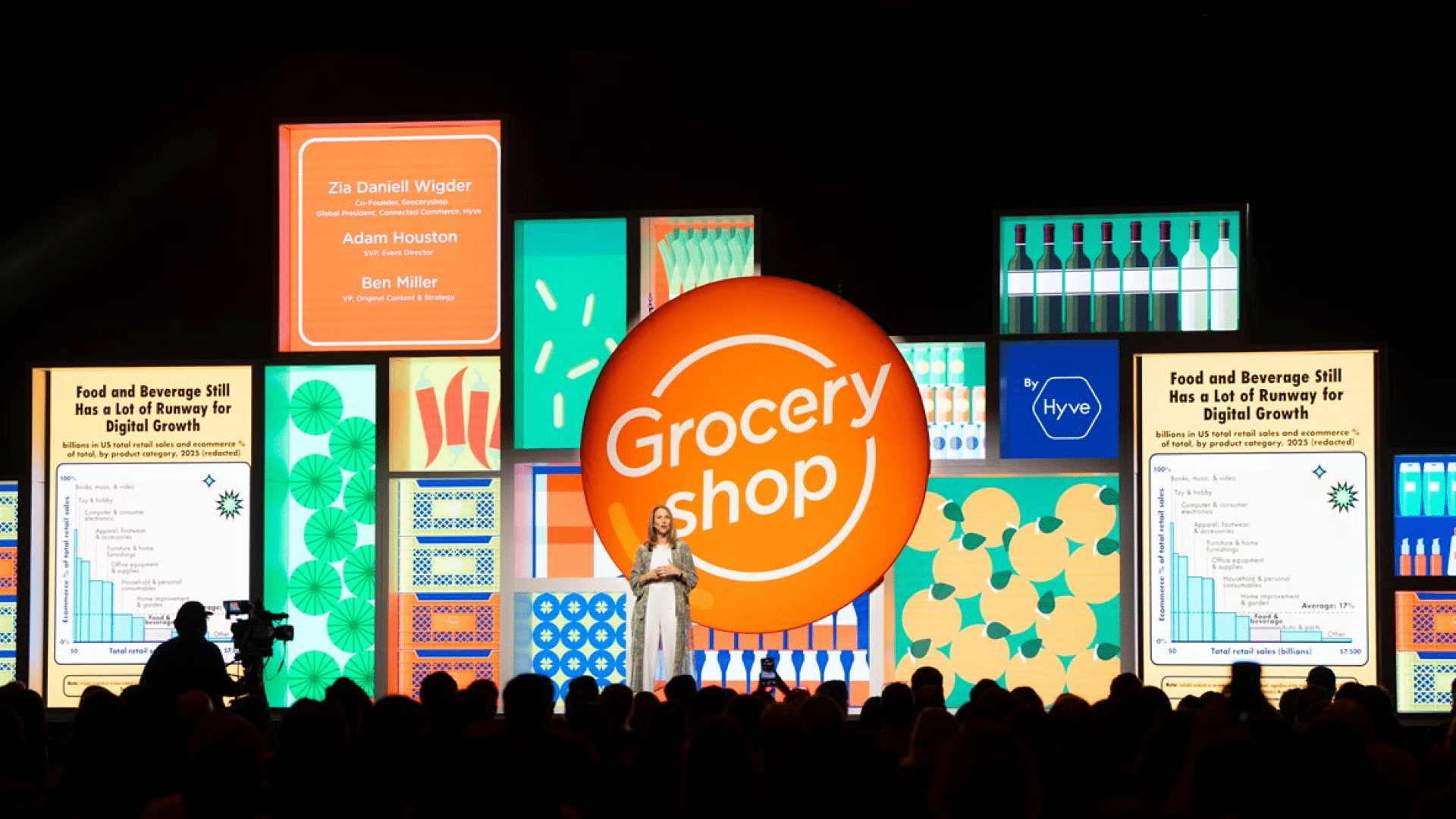
Retailers showed off their AI assistants in Las Vegas for Groceryshop 2026. The sessions that filled up were about why so few AI pilots ever reach the P&L.
Most organisations are still stuck in the gap between an AI pilot and a number on the P&L.
Three days at Mandalay Bay, more than 150 sessions across five stages. Quantium’s Kylie Gleeson and Mark Davey were at Groceryshop 2026 in Las Vegas from 22 to 24 September. Here we share what stood out, and how everyone sought to address the AI-to-P&L gap.
One shift was clear throughout all discussions: customer expectations are rising and the need for personalisation is growing quickly. Customers want more affordability and value, while retailers want to drive efficiency, productivity and conversion across multiple channels. Retailers took the main stage to talk about the assistants they have built. Instacart’s Chris Rogers, Kroger’s Yael Cosset, Hy-Vee’s Jeremy Gosch and DoorDash’s Andy Fang all spoke.
Brands spent the week working out how to stay discoverable now that the search bar has become an answer engine. There was a dedicated AI-Powered Shopping Experiences theme. There were tactical sessions on generative engine optimisation, and on getting data and ecommerce platforms ready for agentic traffic. There was also fresh research on what is genuinely driving shopper adoption of AI tools, rather than what vendors assume will drive it.
AI has moved into the shopping journey itself. Grocery will be one of the categories most affected by AI, because it can remove friction, deepen customer understanding and predict future behaviours. Connecting AI to a number on the P&L is a very different conversation to the one this industry was having twelve months ago.
For every session on what AI could do, there was one on why it so often does not. Mars Snacking’s global chief technology officer talked about establishing the right tech, teams and privacy guardrails. Church & Dwight and Kimberly-Clark focused on turning data analytics into measurable productivity and profitability. An entire theme was devoted to transforming and optimising business operations under slim margins.
Those sessions filled up because the pilot-to-P&L gap is real, and most organisations are still sitting in it.
Four themes that stood out
1. AI-powered shopping and discoverability
The digital shelf is being rewritten as shoppers turn to AI assistants instead of search bars. Generative and answer engine optimisation (GEO and AEO) can get a product into the answer, but getting recommended is not the same as getting bought.
“Conversion is now the most desired metric,” says Mark Davey. “While last year we challenged channel mix, right now the best retailers are providing customer experience, no matter which channel. Retailers are solving for a customer need, often urgent and quality is non-negotiable.”
2. Retail media measurement
“Retail Media will only develop by building a shared experience for brands, retailers and consumers,” says Mark Davey. “If we take a second to reflect, COVID taught the world a lot! Our media consumption and supply chain has been completely transformed.”
The open question is whether retail media can prove what it delivers. Closed-loop attribution only closes when the loop ends in a transaction record. Incrementality is what separates media that grew the category from media that simply claimed a purchase that was going to happen anyway.
Two years ago the conversation was largely about reach. This year Costco, Kroger Precision Marketing and Mondelēz shared a session on what is holding retail media growth back. EMARKETER, P&G and PepsiCo held another on where the analyst research now points.
3. Value, convenience and GLP-1
Value, convenience and GLP-1 are changing what goes into the basket. Target, Chobani and Roxberry Naturals used their session to show how assortment must follow shifting dietary preferences. These are assortment, NPD and price pack architecture decisions, not marketing themes. GLP-1 adoption shows up as a change in basket composition long before it appears in a category share report. Suppliers who can see it at basket level are making range calls their competitors will make six months later.
“We must think carefully about product assortment, innovation and consumer trends,” says Mark Davey. “Australia and New Zealand have always had a ruthless focus on quality and health, while other parts of the world often vary across a much larger population and spectrum. Value, convenience and now GLP-1 is without a doubt casting the loudest voice, with ‘customer curiosity’ quickly rising.”
4. Capability is the constraint, not technology
In the organisations moving fastest, the executives use these tools themselves. They do not just get briefed on AI – they build it into their daily work.
“Some of the best leaders globally had a clear vision of what success looks like over the next 12 months,” says Mark Davey. “Leading by example with the responsible use of AI allows your business to travel faster, with greater accuracy. With speed comes risk, but staying focused on the agreed outcome is the most important ingredient in a complex world.”
Quantium runs AI Executive Edge for C-suite leaders and AI Board Edge for board directors on exactly this premise.
Why the gap persists
Closing the gap comes down to what you feed the model, not which model you pick.
The difference between a demo that impresses and a system that changes a number on the P&L is rarely the model. Every serious player now has access to the same frontier models. Quantium partners across Anthropic, OpenAI, Google Cloud, AWS, Azure, Databricks and Snowflake, and the pattern holds on every one.
What differentiates is context. Specifically, three things:
1. Proprietary data
An AI system reasoning over your actual transaction data is answering a different question to one reasoning over the open internet. One tells you what shoppers did. The other tells you what has been written about what shoppers might do.
2. Workflow understanding
An agent that does not know how a line review runs, how trade spend is committed, or when the range decision is locked will produce output that is technically correct and commercially useless. This is the thinking behind Q.Checkout AI, which pairs real Woolworths transaction data with the commercial frameworks Quantium analysts use every day.
3. Production discipline
Done well, governance, security, integration and change management are what let a pilot scale safely. They are also where many pilots stall.
Quantium has spent 24 years building AI in these industries, and transformed its own business before advising anyone else to. More than 1,200 people across 11 locations have worked through the same security, adoption and integration problems that FMCG and retail organisations are navigating now.
The question worth taking home
Kylie Gleeson, Group Executive and Global Head of Retail and Consumer, and Mark Davey, Executive Vice President, General Manager, North America, represented Quantium Retail and Consumer at Groceryshop. They came home with the same conclusion the program kept circling.
The biggest questions across our industry are highly consistent. The first is how you shift from being individually AI native to enterprise-wide AI native. The second is how you find industry expertise you can trust while delivering business impact.
The interesting question is no longer what AI can do in grocery and CPG. It is what it will do in your business, on your data, against a number you already report.
If that is a conversation worth having in your business, we would welcome it. Talk to our team today.