


The $10 million question Bega answered in the room
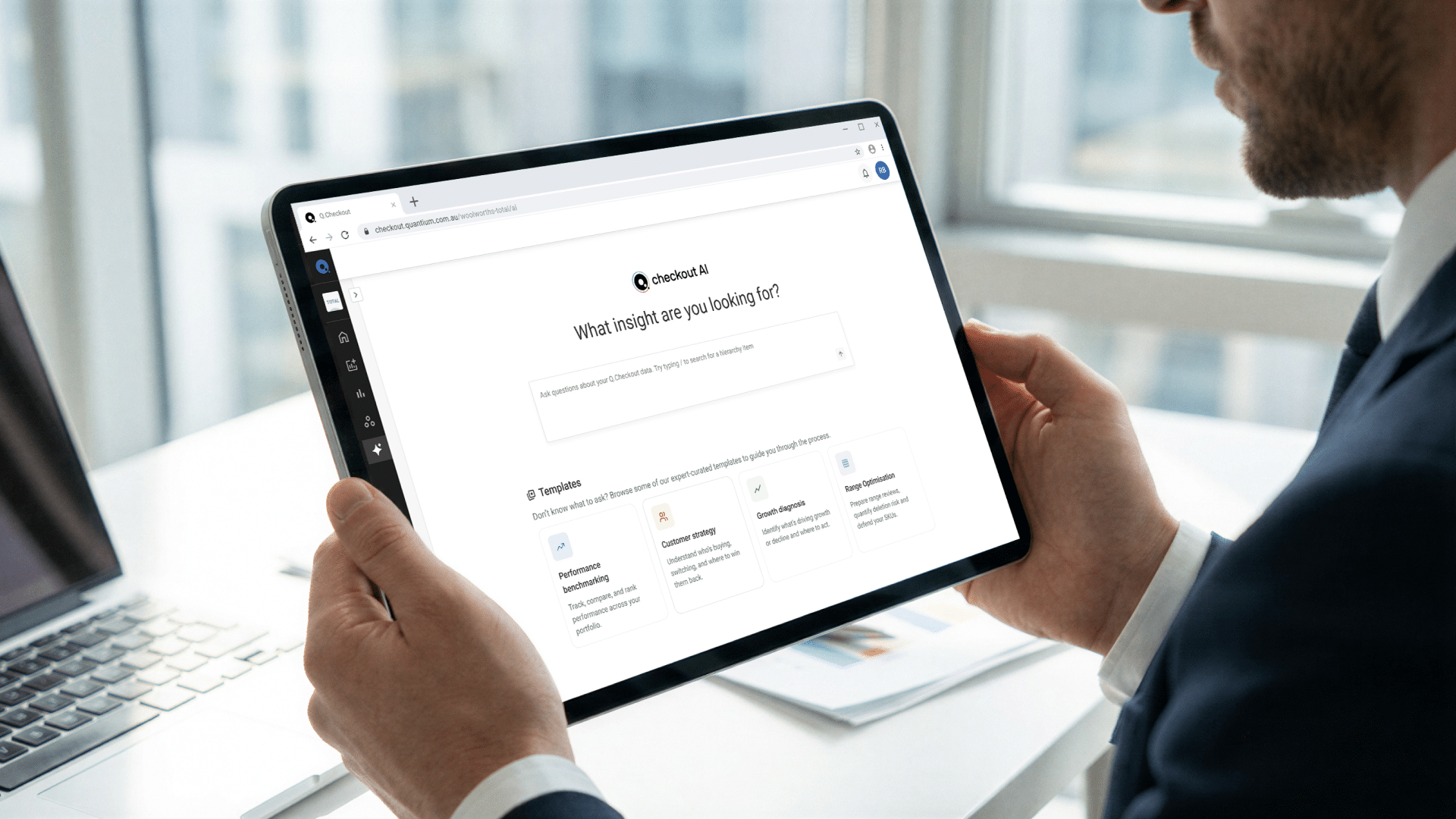
At Quantium’s AI Advantage in FMCG event, Bega Group’s Richard Hechter shared how Q.Checkout AI let him work through a $10 million range question with his buyer, live, just three weeks after he started using it.
Quantium Consumer brought 128 senior FMCG leaders together across two invite-only evenings in Sydney and Melbourne. The AI Advantage events were not a conversation about technology. They were a conversation on how AI could impact the P&L.
The starting point was a gap most commercial teams will recognise. Showing a board an AI strategy has become straightforward. Showing it in the numbers has not. Research from BCG and The Consumer Goods Forum put a figure on it: 88 per cent of CEOs report seeing an AI benefit, but only 14 per cent can quantify it. Three in four consumer goods companies remain stuck in pilot mode. As Kylie Gleeson, Quantium’s Group Executive and Global Head of Retail and Consumer, put it on the night: having an enterprise LLM is step zero, not a strategy. The question is where you point it.
One answer came from the room itself. Richard Hechter, Senior National Business Manager at Bega Group, described a buyer meeting three weeks after he started using Q.Checkout AI, when a $10 million range question landed live across the table. Read on to see how he addressed the $10 million question.
I had only been using Claude for three weeks when a question I could not have prepared for came up in a meeting. I look after the foods account at Bega, so yoghurt and cream, with a team alongside me working on Vegemite and Bega peanut butter. I was sitting with my buyer, working through a range optimisation project they were considering. Then came the obvious next question: where would those sales come from?
The gap we were talking about was around $10 million of incremental sales. What made it different from every version of that conversation I have had before is that it did not get parked. Normally this is the point where it goes back to the category team and comes back next week. This time we had the chance to work it through while we were both still in the room.
The version of this I usually tell is a quieter one. I am a Melbourne-based supplier, so I fly interstate for a retailer meeting, and I am in a taxi on the way in trying to get information quickly and accurately before I walk through the door. The $10 million question was the same need for a fast, accurate answer, only this time there was no taxi ride to prepare in.
What I did in the room
I brought the data up and shared my screen. What I said was roughly this: here is what Q.Checkout AI says, here is what I think the right thing to do is, and we will come back in two weeks with a formal plan. And I got about 90% of the way there on the switching and the value we could add, live, in the room. The two weeks did not disappear. That is the part I would want people to notice. The formal plan still took a fortnight, the same as it always has. What changed is that the fortnight was no longer the answer to the question. It became the follow-up to an answer I had already given, which meant I was still inside the decision instead of waiting outside it.
There was something else that came out of it that I did not expect. Using Q.Checkout AI in front of the buyer gave the whole thing a different kind of credibility. I could say to him that if he thought something looked wrong, tell me, but I was hoping we were reading the same page. You cannot do that with a deck you built last week. The wider unlock is not having to set up another meeting to answer the question. If you can have the conversation while everyone is still in the room, everybody moves faster.
How I got there in three weeks
Executive buy-in is what makes any of this possible, and Quantium have done a lot of work with our exec team to get them on that journey. What I did from there was unglamorous, and I want to be honest about that. When I got access to Claude, I used it hard. I was unapologetically maxing out my tokens and hitting budget limits, and every Thursday and Friday I sent performance information out to our executive team so they could see what it was adding. That was deliberate. I was not trying to be careful with it. I was trying to make the value visible quickly, before anyone had the chance to lose interest. Claude is not the only part of it. From a sales perspective I am trying to champion the use of whatever earns its place, whether that is Claude, Copilot Premium or Checkout AI to get to insights faster. We are still working out, at an individual contributor level, where AI can and should be adding more value to us. The same logic applied to getting the dashboard adopted. Two weeks ago I had a horrible trading week. I could have sat on it. But I needed the dashboard to be used across the business, so I put the decline in front of everyone, explained why it was semi-planned, and moved on. Someone else would have found it anyway.
Democratising that information is what makes that necessary, and it is the bit I think a lot of people in sales have not fully sat with yet. There are times when I do not want to share bad news and I would rather obfuscate it. With this much data available on both sides, you have to face into the problem. The old school of salespeople hiding behind a bad week, or just not sharing that week’s numbers, is probably dead. I think that is a good thing.
Getting everything into one place
The next piece is bigger than any single tool, and it is where most of my thinking sits at the moment. We have a broad range of internal information and an enormous amount of external information across all of our big customers, and it does not live in one place. So I have been talking to the Quantium team about what a Workbench would look like for us, and how we bring all of that together. We are still probably at proof of concept on it. The ambition is to get us to a point where we are AI first as a business, and that will not happen while the information sits in separate places.
Play with it outside work too
The other reason I got to this point quickly is that I did not only use AI at work. I got frustrated with how slowly things were moving, so I started messing about with it in my own time. I ended up building and launching an app on the App Store called Daily Driver. Last night I built myself a dashboard for it, pulling in my AWS credits, my ad spend and my download numbers, purely because I wanted to see if I could. Then I took what I had learned and applied it to the dashboard I need for work. That is how the Workbench conversation started to make sense to me. I had conceptualised the thing at small scale on my own data before I tried to picture it across the business.
If all you ever do is use AI in the office, you will not be at the frontier of it. Becoming AI literate is not a work project. It ends up being all areas of your life, and the work version gets much easier once the personal version is second nature.
Where I would start
Test and learn and have a play with it. I like new shiny toys, which is probably the only reason I am this far along. Beyond that, think about the meeting that matters most to your year. Work out the hardest question that could land in it. Then be honest about whether you could answer that question while you were still in the room. We are nowhere near where we could be at Bega. But I was three weeks in when that $10 million question landed, and three weeks was enough to stay in the conversation.
Views expressed by Richard Hechter are his own, shared as part of the AI Advantage in FMCG event.
About the AI Advantage in FMCG event
AI Advantage brought together 128 senior leaders from 78 FMCG and retail companies across two invite-only evenings in Sydney and Melbourne. The focus was practical: moving AI from roadmap to measurable P&L impact. Richard Hechter was one of the client voices who shared their experience on the night, and the views above are his own.
You can read the full event wrap-up, including perspectives from Quantium leaders, Google Cloud and other FMCG clients, here.
Q.Checkout AI gives commercial teams the visibility to answer category questions in the moment they arise, using real shopper transaction data from Woolworths. To understand what that looks like for your category, talk to our team.